

Report Methodology
This report is based on 32 direct testimonies collected through individual interviews conducted by researchers of the Center Against Violence and Hatred between June and November 2025. The interviews were conducted either in person in safe locations or via encrypted communication channels to ensure protection. The testimonies underwent a multi-stage verification process that included cross-checking dates, reviewing available evidence, and examining the internal and external consistency of the information.
All personal data of the witnesses has been withheld at their request, and the report relied on comparison between cases to identify patterns without generalization.
Introduction
Between the end of 2024 and the end of 2025, the Center Against Violence and Hatred in Syria documented an escalating series of arbitrary arrests and ill-treatment of detainees, mainly in the capital Damascus, the Syrian coast, Homs, Aleppo and the Hama countryside, all of them members of the Alawite community.
This report is based on 32 testimonies obtained directly from victims or witnesses, and on investigation and verification work that required nearly six months of continuous effort to review and verify the information before arriving at this report.
The report documents various patterns of violations committed outside any form of judicial and legal oversight, and concludes in many instances that the judiciary is almost paralyzed and cut off from some prisons, with the arrest and detention files of hundreds of detainees never passing through it.
The documented patterns range from physical and psychological torture, some of which led to death, through arbitrary detention and enforced disappearance, to the absence of the rule of law and the transformation of the new security agencies into absolute authorities that are subject to no oversight and fail to meet standards of justice.
Compiling these cases and analyzing them by type of violation allows a deeper understanding of the mechanisms of violence, and reveals the new structure within which the security agencies operate, as well as its impact on individuals’ lives, security and dignity. It is an attempt to shed light on the dangers of this reality and of building security and military institutions on discriminatory religious and sectarian foundations and doctrines that permit the abuse of certain communities and the commission of violations against them, based on fatwas and affiliations far removed from the principles of the state and the rule of law.
Arrest of an Elderly Man to Pressure One of His Sons into Surrendering
In July 2025, a security patrol in a neighborhood of the capital Damascus stopped a man in his fifties and asked for his ID. After examining it, they asked him about the whereabouts of one of his sons. When he replied that he knew nothing about him, they responded by beating him and hurling sectarian insults at him, calling him a “pig”.
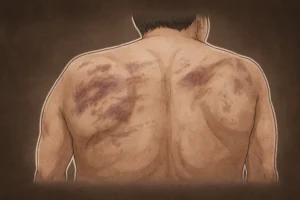
The witness says he was taken to a security center in the capital, where a member nicknamed “al-Sheikh” tortured him by whipping his back in multiple torture sessions over three days of detention, while the recurring question during interrogation concerned the whereabouts of one of his sons. On the fourth day, the wanted son/daughter turned themselves in to the same security agency, after which the father was released, while the agency kept his personal documents. To this day he has not dared to return to the security center to retrieve them, and no one from the center has contacted him to hand them over, despite his urgent need for them.
The witness adds that he did not dare to visit any medical center for treatment because his identity documents were being held and for fear of being detained again. Meanwhile, a civil society organization in Damascus — after our team contacted it — sent a pharmacist to his home to provide ointments and treatment for the wounds caused by the whipping, as he was unable to move for several days after his release.
Detention aimed at pressuring a family member constitutes a flagrant violation of Article 9 of the International Covenant on Civil and Political Rights. Physical torture and sectarian insults also contravene the Convention against Torture, and are regarded as an act of collective punishment prohibited under international law
Death Under Torture and Abuse in Prisons
In June 2025, a man in his thirties from the Syrian coast died in a security center on the outskirts of Damascus affiliated with the Damascus Security Directorate. According to the testimony of a fellow detainee: “Two new detainees entered the dormitory, which held 28 people. One of them was very thin, short and dark-skinned, and looked as if he had either been on hunger strike or denied food. For several days they took him out every day for torture, and when he came back they prevented us from talking to him or approaching him. On the fourth day he returned from torture exhausted and was thrown at the entrance of the dormitory. We moved him to a corner, and within hours he breathed his last. We screamed and called out to them to take him to hospital. The Sheikh came, looked at him lying dead, and ordered the guards to take him to the hospital for burial.”
One torture survivor, a teenager under 18, said he was arrested in the street after being asked about his sect, and spent several months in detention, during which he was tortured for nearly 60 days. He was severely beaten with green plumbing pipes as well as with the rubber gasket that surrounds a washing machine door, both of which are extremely painful, as he described.
According to the detainee, he was released after a sum of money was paid to an intermediary who undertook to secure his release from prison in exchange for payment, which is what happened. His mother notes that the security branch, which she saw with her own eyes the arresting car enter, consistently refused to acknowledge that her son was being held there, and did not admit his detention until an intermediary intervened, taking more than 11,000 US dollars in exchange for helping to uncover his fate and secure his release.
While collecting testimonies, we identified a wide range of detention sites outside police stations and traditional official prisons. Some are tourist facilities where security or military forces affiliated with the Syrian transitional government have been stationed; others are private villas and farms where factions affiliated with the Ministry of Defense are stationed, some of which have kept their previous banners and names despite officially announcing their integration into the Ministry.
Among the detention sites we identified where torture took place is a hotel in Latakia Governorate that was converted into a detention center. According to several testimonies we obtained from people detained in the hotel in September, October and November 2025, detainees there are subjected to continuous physical torture and sectarian insults. One person released from the site said that among the forms of torture he endured, a guard put a rifle to his head and pulled the trigger, but it was not loaded, causing him to faint and involuntarily urinate in his clothes out of fear. The witness, a young man who is an only son, says that after this intimidation he was taken into an interrogation room and beaten there until morning, when he was released after the intervention of an intermediary with influence over the authorities who was known to his family.
Meanwhile, others detained with him were severely beaten and subjected to sectarian insults, and remained in detention for more than 20 days without trial or being brought before a judge before being released.
Indiscriminate Arrests
In August 2025, a security force arrived at a village on the outskirts of a coastal city and stopped in front of a shop where five people were sitting drinking coffee. The members got out in their military gear, asked about a specific person among those sitting, and checked his identity. Once they had confirmed it was him, they arrested him along with everyone who was with him, even though their mission required arresting him alone.
About two weeks later, the authorities announced that they had arrested a suspect linked to remnants of the former regime and that he had been referred to the judiciary. After verification, the documentation team found that this suspect had been referred to the judiciary on 21 August 2025, but the people who had been sitting with him continued to be held at the same detention site from August 2025 until the preparation of this report in December 2025.
The detainees’ families approached the judicial authority in Latakia, demanding to visit the detainees, that clear charges be brought against them and that they be given a fair trial, but the judiciary did not respond and did not confirm their detention. Unable to reach their sons through the judicial authority, they met with an executive official in the Syrian government, who made several calls and then obtained for them a visit to their detained sons at the headquarters of one of the security agencies. Signs of beating were visible on their faces, they appeared to have lost weight and they moved sluggishly, according to the families’ description.
The detainees’ families affirm that to this day they have not been able to appoint lawyers for their sons, nor have they been allowed to visit again, and they do not know what has become of them. They noted that during the only visit they were granted, they learned from their sons that they had been interrogated about their relationship with the accused who had been referred for trial. The sons affirmed that it was an ordinary acquaintance, that they knew nothing about his activities, and that gatherings in front of shops and cafés for leisure usually include people who are not necessarily close friends or partners — it is enough for them to be acquaintances, according to the detainees’ families.
Detention in unofficial places, combined with torture and sectarian humiliation, constitutes a violation of the Convention against Torture and of Article 14 of the International Covenant concerning the right to a fair trial. It also constitutes a flagrant breach of the State’s duty to register every detainee and inform their relatives of their whereabouts.
Killings and Sectarian Abuse at Checkpoints
Over the course of a year, we documented various patterns of sectarian abuse at checkpoints, which have continued at varying intensity until December 2025.
Reviewing the documented incidents and violations and their dates, it can be said that they began in December 2024 and escalated significantly after the massacres on the Syrian coast in March 2025. They are still ongoing today.
Practices at checkpoints on the ground include direct sectarian insults and abuse, such as cursing and ordering people to bark, extending to beatings that range from quick slaps to violent blows with rifle butts, and up to torture to death.
In July 2025, we documented the death under torture of a young man hours after his arrest at a security checkpoint in one of the cities of the Syrian coast. He was severely beaten before being transferred from the military checkpoint to a security center, and from there to a government hospital, but he died before reaching the hospital as a result of the torture.
According to witnesses, the assault and beating were directly accompanied by sectarian questions put to the victim, followed by sectarian insults and verbal abuse against his sect and his family.
In May, a checkpoint in Baniyas stopped a young man in his twenties who was on his way, in the evening, to visit a friend in hospital following a traffic accident. It is customary among village people to rush to help in such situations, with some villagers going to the hospital to support the patient and their family, whether financially or morally, or even by donating blood and accompanying the patient, according to the victim’s mother.
On the road, a military checkpoint at the village entrance stopped him. The members hurled sectarian insults at him and slapped him several times, then seized his mobile phone and searched it unlawfully, before one of them told him: “I’ll load the rifle and you get on your motorbike; if you manage to escape before I shoot you, you survive.” He immediately sped off on his motorbike and moments later heard gunshots, so he accelerated until he reached home. He did not leave the house again until the checkpoint was removed, and since that day he has suffered from psychological trauma and does not leave home.
Other testimonies we obtained point to beatings, violence and the theft of mobile phones at checkpoints. Searching mobile phones is a common practice at checkpoints and violates privacy. One witness says that an official checkpoint took his mobile phone, looked through the photos on it and asked him about his sister, who appears with him in the photos, then stole the phone and never returned it. This led the family to fear that his sister might be kidnapped and to restrict her movements outside the house.
Sectarian abuse at checkpoints, including beatings, humiliation, death threats and actual killings, constitutes a violation of Article 7 of the International Covenant on Civil and Political Rights, which prohibits torture, and of Article 26, which prohibits identity-based discrimination. Killing in detention or at checkpoints is considered an extrajudicial killing for which the State bears clear responsibility. Searching and stealing phones constitutes an explicit violation of the right to privacy under Article 17 of the International Covenant.
Detention of a Young Woman in Damascus, Her Transfer Between Security Centers, and Denial of Family Access
In September 2025, a woman in her thirties disappeared in one of the informal neighborhoods of the capital Damascus after a car carrying armed men stopped her and took her to an unknown location. Her family believed she had been kidnapped and posted news of her disappearance on social media. A week later, they received an anonymous call demanding that they delete the posts and informing them that she was being held by the security agencies, specifying the branch.
The family went to the branch, from where they were referred to a police station in the capital. When the family arrived at the station, its staff confirmed that she was being held there as a suspect in a case under investigation, but prevented the family from seeing her or speaking to her, on the pretext that she was awaiting presentation before a judge.
Over the following weeks, the family kept going to the police station and the Public Prosecution, but were never able to see her and obtained no official information about her legal status, even though the law requires that a detainee be brought before the judiciary within 24 hours of arrest. Later, the police station allowed the family to send personal necessities, but without allowing them direct contact with her. As of 4 December 2025, the family had still not been able to see her or actually confirm her place of detention or her health condition, beyond what the authorities at the station said.
Detention of 400 Young Men Without Trial
Detention without trial is one of the most common violations during the transitional period in Syria. We were able to record nearly 400 cases of detention without trial in one prison located in the countryside of Aleppo Governorate, and there are hundreds more in prisons in Idlib Governorate. What they have in common is that they are officers and soldiers of the dissolved Syrian army.
Most of those held in these prisons were detained between 1 and 10 December 2024, and the majority were detained after laying down their weapons and leaving their military units in December 2025.
Among the detainees is a soldier who had been imprisoned in a notorious Syrian prison for refusing military service. After leaving prison, he was transferred directly to continue his service in Deir ez-Zor. Before the fall of the regime, he left his weapon along with his comrades and they decided to set out on foot toward Homs Governorate. When they reached the al-Sukhnah area, they were arrested; they numbered about 1,500 people. They were first held in Hama Central Prison until May, then distributed to other prisons, and they remain in detention as of the preparation of this report in November 2025.
According to testimonies from a group of the detainees’ relatives, they were able to visit them for the first time in July 2025. The detainees had been interrogated and were informed that the investigation had not proven their involvement in any crimes, but that they were undergoing a disciplinary period as punishment for their service in the dissolved army and security agencies, after which they would be released.
Their relatives’ testimonies indicate that they approached the judicial authority to clarify the detainees’ cases, the charges against them and the legal proceedings concerning them, but found no files for them in the judicial departments and could not access the interrogation records despite hiring lawyers. The detainees, for their part, confirmed to their relatives that they had never been brought before any judge and had only been interrogated in the prisons where they were held.
The authorities had opened a center at the Municipal Stadium in Deir ez-Zor to receive complaints against members of the dissolved army and security forces, and asked residents to file complaints against those who had committed violations and crimes. A source on the complaints committee told the team preparing this report that the number of complaints received was very limited, no more than 20, and that not all of them concerned war crimes; some related to ill-treatment or financial corruption and were individual cases, some against people in detention and some against people whose fate has not yet been determined.
Families’ testimonies indicate that prisoners receive humane treatment in these prisons, and their sons have not reported any violations to them since their transfer from Hama Prison. They noted that violations were concentrated in Hama Prison and were relative, and that a number of guards there were replaced during their detention because of their ill-treatment and use of torture, according to prisoners’ families who relayed this information from their detained sons.
According to the testimonies, the prisons are under the Ministry of Defense, and those supervising them are addressed as “al-Sheikh”. Smoking is prohibited, there are regular meals and regular showers, and prisoners are treated with an acceptable degree of respect and human dignity. The prison is also run according to a religious approach, with hours dedicated to playing religious audio recordings and prisoners being called to prayer.
The prisoners in these prisons come from various religions and sects in Syria and all receive the same treatment; according to the testimonies, we did not record any negative or positive discrimination in favor of or against any detainee.
Legal Characterization
The violations documented above constitute grave human rights violations, contravene the International Covenant on Civil and Political Rights, and breach the provisions of the Convention against Torture. These violations include: arbitrary arrest and unlawful detention, torture and ill-treatment, extrajudicial killing, as well as enforced disappearance, discrimination and persecution on sectarian grounds, and violation of the right to privacy and personal inviolability, in addition to the absence of effective judicial oversight, which reinforces impunity.